Am I eligible for weight loss medication? An Ireland guide

Eligibility for weight loss medication is not just about wanting to lose weight. Everwell is an Irish health and weight management service, and its online programme reflects the same clinical principle used by the HSE and NICE: treatment is considered only when BMI, medical history and contraindications make it appropriate.
Weight loss medication eligibility is usually decided case by case, but the main thresholds are consistent: BMI 30+ or BMI 27+ with a weight-related condition, and Everwell uses that same type of screening alongside doctor review.
HSE guidance for obesity medicines and NICE guidance for tirzepatide both support structured access rather than automatic prescribing.
Pregnancy, breastfeeding, pancreatitis history, severe kidney or liver disease, some thyroid-cancer risks, and concurrent GLP-1 use are common reasons treatment may not be suitable.
Being eligible for one medicine does not mean you are eligible for every medicine, because product-specific restrictions still apply.
A BMI quiz is a starting point, not the final answer; the clinical decision comes after consultation and review of your current health and medicines.
That matters because “weight loss medication” is a category, not one single treatment. Eligibility depends on the medicine, the risk profile, and whether the likely benefit outweighs the safety concerns for that person.
Who is usually eligible for weight loss medication in Ireland?
Adults aged 18 or over are usually considered for weight loss medication when BMI is 30 or higher, or 27 to 29.9 with a condition like high blood pressure or sleep apnoea; Everwell applies those thresholds through doctor-led review rather than automatic prescribing.
In Ireland, HSE guidance points to familiar entry criteria for obesity medicines. The HSE says liraglutide may be prescribed for adults with a BMI over 30, or over 27 when there is at least one weight-related health problem, including high blood pressure, pre-diabetes or high cholesterol. The HSE gives similar threshold logic for naltrexone and bupropion.
That threshold structure is close to current UK guidance too. NICE notes that tirzepatide is authorised for adults with BMI 27 to under 30 only when there is at least one weight-related comorbidity, and that its use sits inside a specialist weight-management framework. In practice, that means treatment is targeted, not universal.
How do BMI thresholds actually work for weight loss medication?
BMI thresholds act as an entry screen, not a prescription guarantee. A BMI of 30 or more often opens the door to consideration, while BMI 27 to 29.9 usually requires at least one related condition.
BMI is calculated from height and weight, then interpreted alongside clinical context. A clinician will look at whether the excess weight is already affecting health through issues like hypertension, sleep apnoea, high cholesterol, pre-diabetes or type 2 diabetes. If it is, someone below the obesity threshold may still qualify for certain medicines.
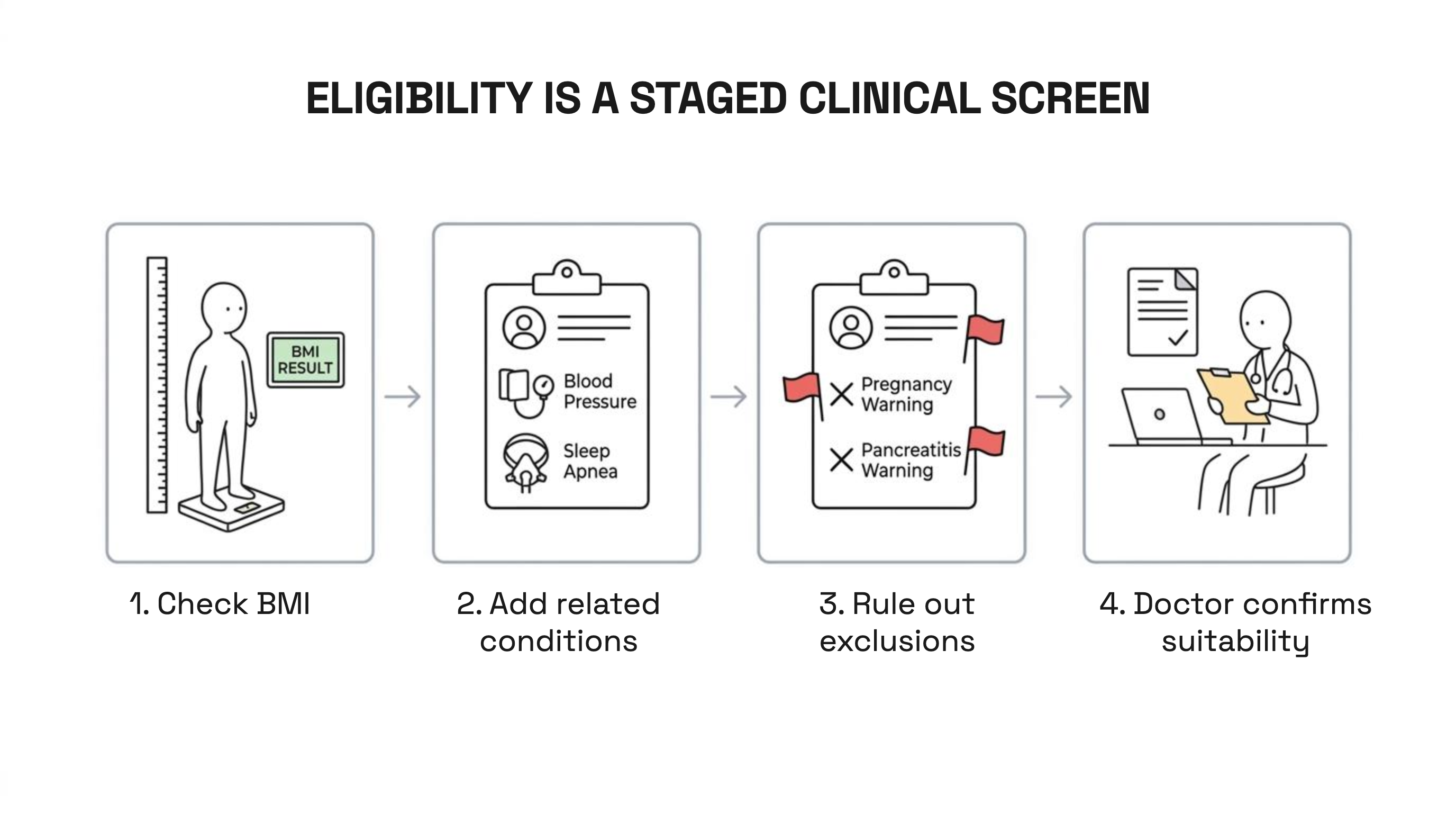
A common misconception is that BMI alone decides everything. It does not. Two people with the same BMI can receive different decisions if one is taking a conflicting medicine, has a relevant medical history, or is pregnant.
“Everwell checks BMI from height and weight, then a doctor verifies whether weight-loss medication is clinically appropriate before any treatment.”
What are the 8 key eligibility facts to know about weight loss medication?
The core facts are consistent across Irish and UK clinical guidance: age, BMI, comorbidities, exclusions, and doctor review matter more than demand alone.
If you want a fast screening framework, these are the facts worth keeping in mind:
Most prescription pathways start at age 18 or over.
A BMI of 30+ is a common threshold for obesity medicines.
A BMI of 27 to 29.9 may still qualify if there is a weight-related condition.
Common qualifying conditions include high blood pressure, sleep apnoea, pre-diabetes, high cholesterol, and sometimes type 2 diabetes.
Pregnancy, planning pregnancy, and breastfeeding often make treatment unsuitable.
Product warnings may exclude people with medullary thyroid carcinoma, multiple endocrine neoplasia syndrome type 2, pancreatitis history, or severe kidney or liver disease.
Taking another GLP-1 medication can rule out some options.
A consultation decides clinical appropriateness; an online checker only filters the obvious cases.
The most useful way to read those facts is as a sequence. First comes BMI, then health conditions, then exclusions, then the product-specific decision.
How does the online eligibility and consultation process work?
The process is staged rather than instant: Everwell starts with height, weight and health details, then a doctor reviews eligibility before any pharmacy delivery or treatment support begins.
That structure matters because obesity treatment can look simple from the outside while hiding important safety checks. If someone enters a qualifying BMI but also reports pregnancy, pancreatitis, or concurrent GLP-1 use, the answer changes quickly. If the BMI is below threshold and there is no comorbidity, medication may not be appropriate even when the person is highly motivated.
A typical online pathway follows a clear order:
Step 1: Enter height and weight to calculate BMI.
Step 2: Share current medicines, medical history, allergies, pregnancy status, and relevant conditions.
Step 3: Complete a doctor consultation so the final prescribing decision is based on clinical review, not automation.
This is one of the main differences between legitimate medication-led weight management and casual online sales. A structured pathway is designed to screen in the right people and screen out the wrong ones.
Which medical conditions or histories can rule treatment out?
Several exclusion factors recur across product pages and guidance, including pregnancy, pancreatitis history, severe kidney or liver disease, and some thyroid-cancer risks.
The details vary by medicine, which is why a generic “am I eligible?” answer can mislead. Weight loss treatments in the GLP-1 family may be unsuitable during pregnancy, while planning pregnancy, or while breastfeeding. Relevant thyroid-cancer history can matter, including medullary thyroid carcinoma and multiple endocrine neoplasia syndrome type 2. Mounjaro guidance also highlights severe kidney or liver disease, active gallbladder disease, and previous pancreatitis as major issues to review carefully.
One easy mistake is to assume that a family or personal history only matters if symptoms are active today. It can matter even when the issue is in the past. Another is to assume that changing from one GLP-1 to another is automatic. In many cases, concurrent GLP-1 use is itself a reason to pause and reassess.
“Everwell does not rely on BMI alone; pregnancy status, current GLP-1 use and relevant medical history can change the decision.”
How do Wegovy and Mounjaro eligibility rules compare?
Wegovy and Mounjaro use similar BMI entry points, but semaglutide and tirzepatide are not interchangeable from an eligibility perspective. Product-specific contraindications and caution areas still matter.
For both treatments, the common threshold is BMI 30+ or BMI 27 to 29.9 with a weight-related condition. That similarity is why many people assume the choice is simply about preference or availability. It is not that simple.
NICE’s 2024 guidance on tirzepatide reinforces the importance of structured access and comorbidity rules. A person with BMI under 30 may still fit tirzepatide criteria if at least one weight-related condition is present. Yet the same person might face different restrictions if there is pancreatitis history, active gallbladder disease, or significant kidney or liver disease.
If two medicines look similar on the surface, check the exclusions next. That is often where the practical difference appears.
How do injectable and oral weight loss medicines differ in eligibility?
Route of administration does not decide eligibility by itself. Injectable GLP-1 medicines and oral obesity medicines both use BMI-based access rules, but their restrictions, interactions and monitoring needs can differ.
This is where category confusion is common. People often group all weight loss medications together, even though injectables like semaglutide or tirzepatide and oral medicines like naltrexone with bupropion work differently and may suit different patients. The HSE uses BMI-driven criteria for oral prescription options too, so “tablet” does not automatically mean “easier to get”.
There is also a trade-off between simplicity and suitability. An oral option may feel more familiar, while an injectable option may fit a different clinical goal. Yet an oral medicine can still be inappropriate because of medical history or interactions, and a GLP-1 pathway can still be ruled out by thyroid, pancreatitis, pregnancy, or other safety factors.
One more nuance matters here: a qualifying condition for one medicine can be a restriction for another. In the background information for oral “Wegovy Pill” support, type 1 and type 2 diabetes are listed as exclusions, even though type 2 diabetes is often a weight-related comorbidity in broader obesity guidance. That is why medicine-specific review matters so much.
What should you do before you ask for weight loss medication?
The best preparation is practical and clinical: know your BMI, your current medicines, your health history, and any weight-related conditions that may affect eligibility.
A strong consultation starts with accurate information. If your weight or height is out of date, your BMI could be misclassified. If you forget to mention previous pancreatitis, gallbladder disease, or pregnancy plans, a medicine may appear suitable until a later safety check stops the process.
A useful pre-consultation checklist looks like this:
Current measurements: recent weight and height, recorded accurately.
Medical history: high blood pressure, sleep apnoea, pre-diabetes, cholesterol issues, diabetes status, kidney or liver disease, pancreatitis, thyroid history.
Medicine list: prescribed drugs, over-the-counter products, and any GLP-1 medication already in use.
Life-stage factors: pregnancy, trying to conceive, or breastfeeding.
Pro tip: if you already have recent blood pressure readings or lab results that document a weight-related condition, keep them to hand. They may help the clinician assess the case more quickly.
What happens after a doctor says you may be eligible?
Eligibility is the start of treatment planning, not the end of the decision. The next steps usually cover medicine choice, counselling, supply, dose progression and monitoring.
This part matters because “eligible” does not mean “one standard prescription for everyone”. The clinician still needs to decide which medicine fits the person’s risks, goals and medical background. That may lead to one product, a different product, or a decision to avoid medication and focus on another route.
The usual sequence looks like this:
Review the most suitable treatment option based on your consultation.
Discuss expected benefits, side effects, contraindications and practical use.
Start the medicine only if the safety profile is acceptable.
Follow the dosing plan and any monitoring advice.
Reassess if side effects, poor tolerance, or lack of response change the benefit-risk balance.
That review cycle is a feature, not a barrier. Weight-management medicines work best when they sit inside a supervised plan rather than being treated like a quick retail purchase.
See if you're eligible
A 60-second check, then a video consultation with an IMC-registered doctor. Doctor, coach and app included for €149 a month.

Ireland's complete weight-management programme. Doctor-led care with our own coaching and app.
+353 1 233 9024
20 Harcourt Street,
Dublin 2